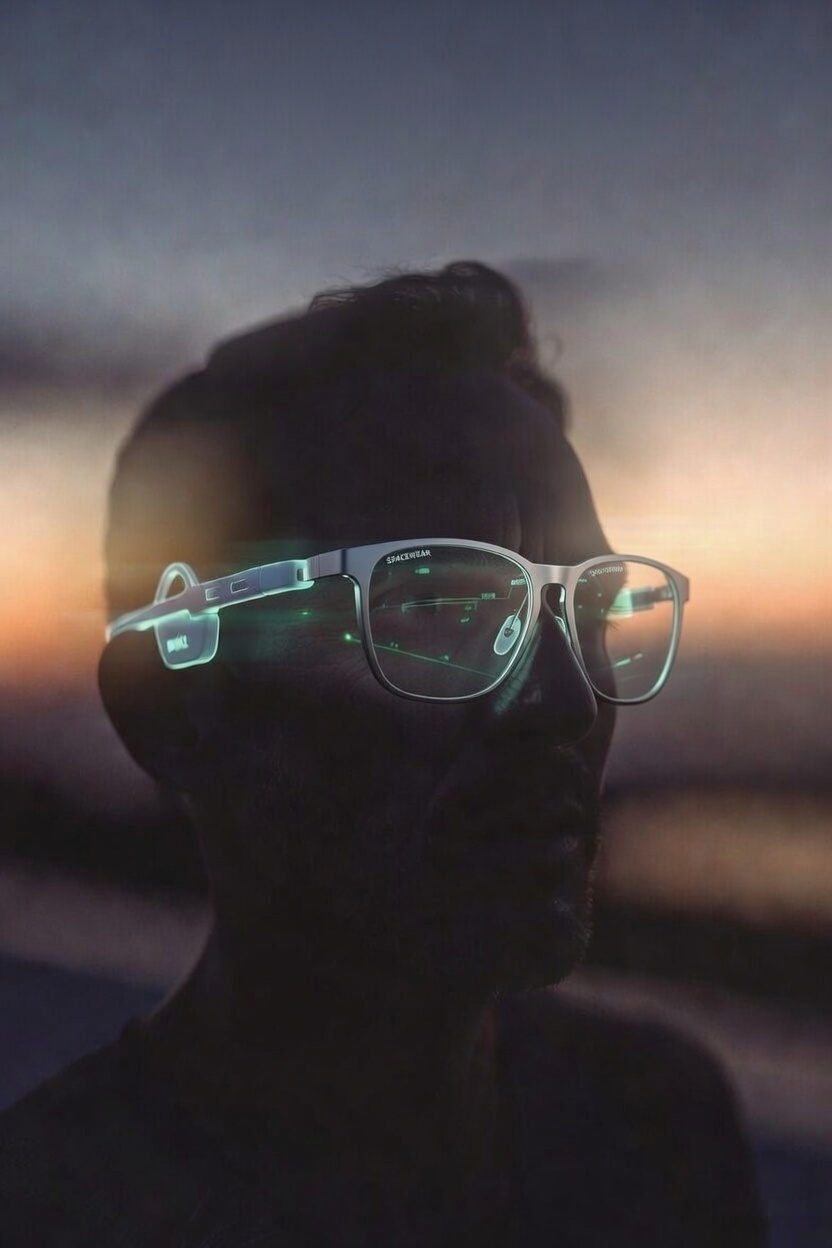
The earpiece node: the unsung hero keeping AR dreams alive
A runner pounds pavement at dawn. No phone in hand. No glance away. Just a subtle vibration through her cheekbone: vehicle right, 3 meters. A bright green arrow flashes in her peripheral vision. She adjusts her stride without breaking flow.
This is the promise of ambient AI; where technology fades into the background until you need it. But there’s a problem.
Every ambitious AR headset from the past decade has face-planted on the same obstacle.
Power.
The ultimate reality is still the **VR contact lens: **the invisible computing promised by companies like XPANCEO and Mojo Vision.
But the physics of putting a battery on your eyeball is brutal. Retinal micro-LEDs are power-hungry beasts. XPANCEO is betting on harvesting microwatts from tears and body heat, a compelling idea that sounds promising.
The lenses everyone wants to build are juice vampires and without a breakthrough, they remain stuck in the lab.
Enter the Earpiece Node: the practical fix not many are talking about. It is the missing link that makes lightweight AR work today, and the key to unlocking the contact lens future tomorrow.
The bridge: ghost frames (the now)
We can’t power full VR contact lenses continuously yet. But we can fix smart glasses immediately. Current smart glasses (like Even Realities or Brilliant Labs) are beautiful, but to stay thin, they sacrifice battery life and thermal performance.
Imagine a slim, titanium-band headset, modeled after Shokz bone-conduction gear that rests comfortably around your neck and ears. When you wear the Node with compatible smart glasses, the Node’s ear hook aligns with the glasses’ temple tip. The gap is mere millimeters. At this range, wireless power transfer efficiency jumps to over 90%. The Node pumps 50–100 mW continuously into the frames. This offloads the battery and the hot processor from your face to the band behind your ear. Your glasses stay cool and featherlight (sub-40g balanced), while the Node handles the heavy lifting.
Crucially, this localised transfer stays well within thermal limits, ensuring no tissue heating near sensitive areas.
This is the bridge. It lets us build glasses that look like Ray-Bans but perform like computers.
The future node: power predictions (2026–2028)
This architecture isn’t static. In the next 24–36 months, three specific technologies will turbocharge what the Node can do:
-
Micro-GaN efficiency: Current inductive chargers waste energy as heat because silicon transistors switch too slowly. By 2027, emerging micro-GaN FETs adapted from EV technology will allow the Node’s transmitter to switch at 13.56 MHz with significantly higher efficiency. This eliminates the hot spot behind your ear, even when pushing enough power for full-color video.
-
Solid-state batteries (SSB): Samsung and TDK are shipping early solid-state cells in 2026/2027 with energy densities approaching 300–400 Wh/kg—nearly double that of current wearables. A future Node will carry 10+ hours of runtime in the same form factor, maybe finally solving the all-day anxiety for power users.
-
Multi-coil dynamic resonance: Today, alignment matters. By 2028 or sooner, we’ll see multi-coil arrays that steer the magnetic field. You won’t need perfect millimeter-precision; the power will jump the gap even if the glasses shift while you jog, maintaining that critical link without a dropout.
The north star: the VR lens (the future)
But the node isn’t just for glasses. It is the infrastructure for the VR contact lens era.
As lens technology matures, the same Node evolves into the Wraparound Power Source.
While beaming high power (mW) to a tiny lens coil at 15 cm is currently unlikely without overheating your head, the Node’s large wraparound coil design changes the math.
It creates a distributed magnetic field that can safely deliver trickle charging (100–400 µW) to future smart lenses.
This enables a hybrid future where the on-lens micro-battery handles burst energy (holograms), while the Node continually tops it up wirelessly, safely below RF exposure limits, ensuring the lens never dies mid-day.
The node buys the contact lens industry time. They don’t need to solve the all-day battery problem anymore; they just need to solve the buffer problem. The Node provides the ocean of power; the lens just needs a bucket.
The power relay: body as ecosystem
Here is where it gets elegant. The Node is the central power hub of a Body Area Network, designed to keep weight off your face while connecting you to heavier compute power elsewhere.
-
The hub (the node): this is your primary battery bank (150–300 mAh) and communications gateway. It powers the glasses, manages audio, and routes data.
-
The brain (pocket core): the node doesn’t run the heavy AI. It connects via UWB (Ultra-wideband) or 60GHz WiGig to the Pocket Brain (the compute brick running the 13B parameter model locally) This keeps your data private and your headset cool.
-
The power (swappable modules): instead of plugging in a cable, the Node features a magnetic dock behind the ear. You simply click in a small battery pod (about the size of a pill). When it runs low, you hot-swap it for a fresh one from your pocket without the system shutting down.
But what about water? The dock uses gold-plated, IP67-rated pogo pins with magnetic self-sealing, similar to modern underwater drone connectors. Sweat, rain, and gym showers are non-issues; the connection is physically robust and corrosion-proof.
-
The endpoints: it beams power and data inductively to your glasses (today) or your contact lenses (tomorrow).
-
The controller: add a smart ring, and you get gesture control—swipe your finger to answer calls that appear as floating text.
This solves AR’s biggest failure mode: isolation. Mojo Vision couldn’t crack wireless charging at the scale needed for immersion. The Node’s inductive relay is proven tech, borrowed from cochlear implants, scaled up for consumer use.
Battery life? 8+ hours on a standard module, with swappable pods extending that indefinitely.
Audio alchemy: hearing without hiding
Whether you are wearing glasses or lenses, the Node handles the sound.
Using bone conduction, it transmits audio by vibrating your cheekbones, sending sound directly to your cochlea. While not replacing high-fidelity headphones for bass-heavy music, speech-optimised drivers provide crisp voice calls and navigation prompts without blocking ambient noise.
The Node offloads audio processing from the eyewear, reducing their power draw and heat output. Remember: micro-LEDs already run hot near your cornea. Add audio processing, and you risk eye irritation. The Node takes that burden, handling voice recognition locally while keeping your ears open to the real world.
Privacy without paranoia
Always-listening AI terrifies people. The Node addresses this with a 200-millisecond rolling buffer. Audio is processed locally for intent (voice commands), then immediately deleted. No cloud uploads. No permanent recordings.
An IR gaze tracker in your eyewear tunes audio to your head position—tilt left during a boss call, and the Node drops to a private whisper-buzz.
Vein-scan authentication pairs the Node directly with your Pocket Brain, unlocking your personal data vault only when it verifies your biometrics, preventing rogue devices from ever accessing your digital life.
The whisper that changes everything
AR was supposed to arrive a decade ago. It didn’t, because we demanded a high bar: a supercomputer on a contact lens.
The Earpiece Node acknowledges the physics. It doesn’t eliminate trade-offs; it manages them. It is a sub-30-gram device that powers the glasses we have today, while building the power grid for the contact lenses we want tomorrow.
Not perfect. Not simple. But the fix that turns ambient AI from a medical curiosity into something you’d actually wear.
The future whispers instead of shouts.