What happens when the world stops wanting something new?
It’s 2035. Gen Z swaps Spotify for vinyl and AI assistants for mindfulness apps. The screen-obsessed world of the 2010s feels almost embarrassing in retrospect, and quietly, without man quite noticing. The smartphone stopped being something you replaced and became something you kept. This isn’t science fiction. It’s the logical endpoint of a backlash that was already visible in 2026, and it’s about to upend trillion-dollar industries.
The catalyst is deceptively simple: phones are lasting longer. Not dramatically, not overnight; but persistently, in ways that are beginning to compound. And if you follow the logic of that shift all the way through, almost everything about how smartphones are made, sold, and experienced starts to look different.
The Seba parallel
The cleanest framework for understanding what’s coming is Tony Seba’s work on electric vehicles. Seba argued that EVs lasting 500,000+ miles would collapse new car sales by 75% by 2030 - not because of environmental policy or consumer virtue, but because the economics of longevity would make replacement simply illogical.
His timelines have proven optimistic (global EV sales reached around 20 million in 2025, roughly half his projection), but the direction he identified has proven correct.
When a technology stops wearing out, it stops getting replaced.
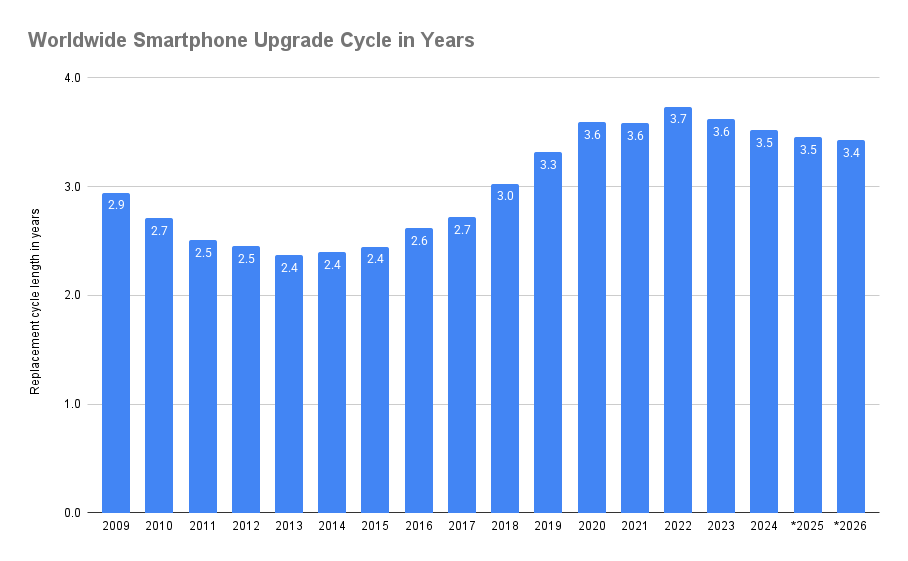
Smartphones are following the same arc. Global replacement cycles have already extended to 3.4–3.5 years, and EU right-to-repair regulations are pushing that figure further. If phones routinely last five or more years - not as a niche choice but as an industry norm - the ripple effects will be as structural as anything Seba described. The disruption may unfold more gradually than his models suggest. But the direction is unmistakable.
The consumer psychology shift
In a culture already fatigued by digital noise, extended phone lifespans don’t feel like a compromise, they feel like relief. The upgrade treadmill trained users to treat phones as disposable fashion items, cycling through devices every 18–24 months. Longevity inverts that logic entirely.
What emerges is something closer to the relationship people have with vintage cameras or well-worn watches: a shift from ownership anxiety to stewardship pride.
The dopamine hit migrates from the unboxing to the personalisation, from buying something new to making something yours. Battery swaps and screen replacements become routine maintenance rather than excuses to upgrade, the way you’d service a car rather than replace it. Consumers start evaluating phones the way they once evaluated washing machines: on reliability, software support commitments, and repairability scores rather than launch-day specs.
This won’t be universal. AI innovations and on-device agents will sustain FOMO in some segments, and premium foldables (growing year-on-year) will keep upgrade cycles shorter at the top of the market. But the centre of gravity is shifting.
Longevity is becoming aspirational.
The business model earthquake
For manufacturers and carriers, this is existential. The entire architecture of the smartphone industry, its retail footprint, its carrier subsidy model, its quarterly hardware cycles, was built on the assumption that customers would always want something new.
When that assumption breaks, the model breaks with it.
Consider what happened to Blockbuster. It didn’t fail because streaming was inevitable in the abstract; it failed because its entire profit structure depended on physical churn: late fees, new releases, footfall.
The moment the product stopped needing to be returned, the business stopped making sense.
Phone manufacturers face an eerily similar trap. Volume-based models that depend on biennial replacement cycles have no obvious future in a world of five-year phones. Margins commoditise. Fixed costs remain. The result, for those who don’t adapt, is a Nokia moment.
The winners will be those who pivot to what might be called phone-as-a-service: lease programmes that bundle hardware, software, repairs, and upgrades into a single monthly relationship, analogous to Apple One or Tesla’s Full Self-Driving subscription.
Service revenue, AI features, cloud storage, premium software updates, insurance programmes - becomes the primary engine rather than unit sales.
Repair ecosystems generate recurring income through authorised service networks and certified parts marketplaces. The phone store stops being a sales floor and becomes a customisation studio, where technicians perform battery transplants and software optimisations with the care of watch repair artisans.
Specialists will emerge around this new terrain. Think Fairphone meets automotive tuning culture, enthusiasts swapping camera modules and customising chassis the way PC builders once treated their rigs. Component suppliers will shift from high-volume, low-mix production toward modular architectures.
Rare earth mining demand stabilises or declines as device longevity reduces new production over time.
Reverse logistics and circular economy infrastructure (urban mining, strategic component reserves, sophisticated refurbishment) become core competencies.
The cascade
Seba’s most useful insight is that disruptions don’t stay contained. They cascade through connected systems in ways that are obvious in retrospect and almost invisible in advance. Extended phone lifecycles are no different.
With stable, long-lived platforms, third-party innovation explodes around cases, lenses, health sensors, and modular add-ons that extend functionality rather than replace it.
Tech giants monetise installed bases through AI agents and productivity tools rather than hardware sales, transforming devices into perpetual revenue engines rather than products with expiration dates.
E-waste generation could decline by 20–50% by 2035 under EU targets, creating space for high-value recycling industries valued in the trillions.
The risks are real too. Innovation could stagnate if longevity reduces R&D incentives. A digital divide could emerge if premium durable phones price out emerging markets. These aren’t arguments against the transition, they’re arguments for managing it carefully.
The invisible device
By 2035, Seba envisioned autonomous EVs as invisible infrastructure, transport you stop thinking about. The decade phone follows the same trajectory.
Hardware fades to background utility. The device becomes less an object you carry than an identity layer you inhabit: updating, healing, evolving alongside you through software rather than replacement.
Apple’s services push, Samsung’s ecosystem lock-in, and Google’s AI integration all point in the same direction.
The question isn’t whether this disruption arrives; it’s whether incumbents recognise it early enough to reshape themselves around it, or whether they become the next Blockbuster: watching their model become obsolete while the rules are rewritten around them.
The winners of the next decade in smartphones won’t be those who sell the most boxes. They’ll be those who make you forget you ever needed a new one.
So ask yourself: what changes if phones become decade-long appliances?