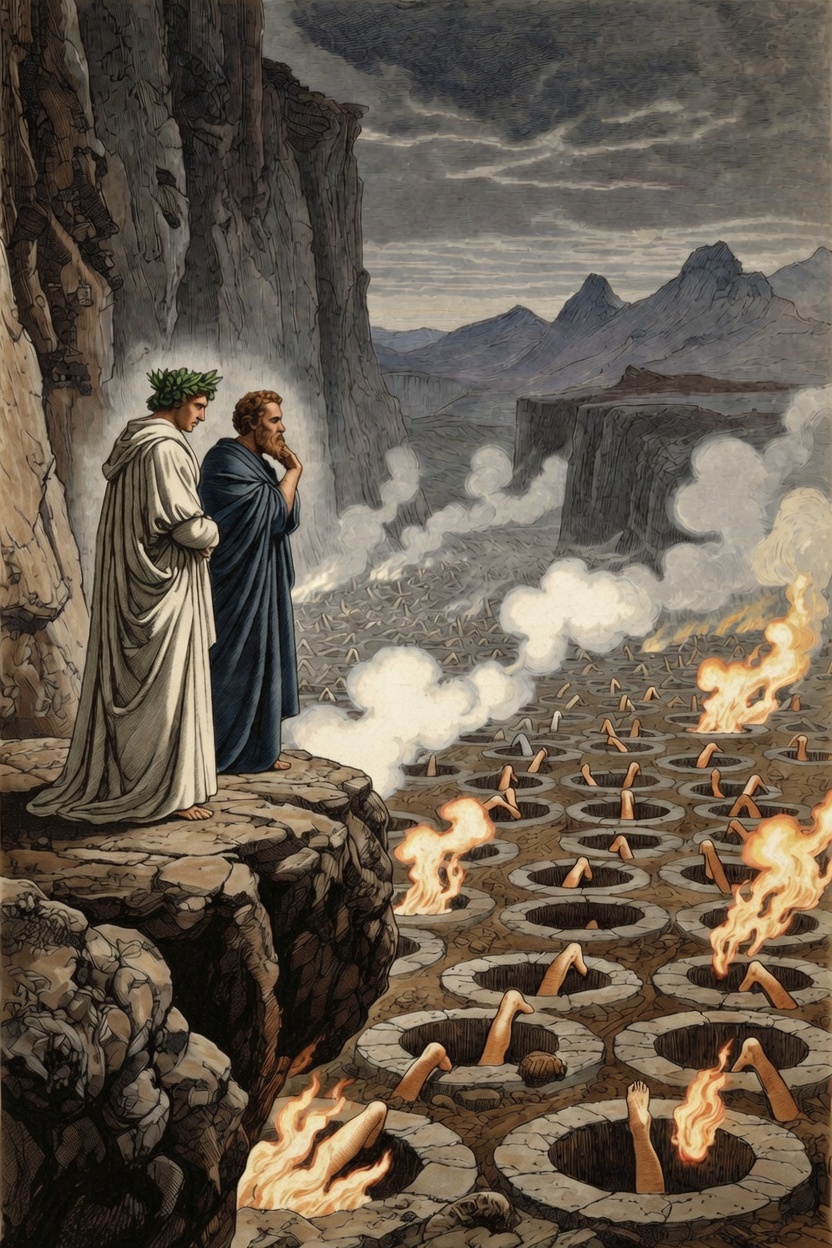
Sixth sphere: independence from passive consumption
In the sixth sphere, we found souls who had broken free from the most insidious trap of modern digital systems, the reduction of users to passive consumers, endpoints in optimisation loops designed to maximise metrics that did not serve their interests.
These souls had devices that amplified critical thinking rather than replacing it, that encouraged active engagement rather than passive consumption, that fostered independence rather than dependence.
Virgil showed me how this worked in practice.
The model surfaced diverse sources the user would not have found through algorithmically filtered feeds, deliberately introducing perspectives that challenged rather than confirmed existing beliefs.
It played devil’s advocate on impulsive choices, asking whether this purchase aligned with last quarter’s stated financial goals, whether this commitment fit into an already overfull schedule, whether this reaction reflected considered judgment or emotional hijacking.
It questioned biases before they could autopilot behavior, flagging echo chambers in reading history, noting when information diet had become too narrow or too tilted toward a particular viewpoint.
The souls in this sphere had reclaimed the capacity for genuine reflection.
Their devices did not tell them what to think but helped them think more clearly.
The model acted as an intellectual sparring partner, as a memory aid for stated principles that might be forgotten in the heat of the moment, as mirror reflecting patterns the user might not see unaided.
This was augmentation in the original sense of the word, making human capability greater, not replacing human judgment but enhancing it.
The contrast with cloud-based feeds was total.
Where algorithmic recommendations created filter bubbles that made users more certain and less informed, this system deliberately punctured bubbles.
Where infinite scroll was engineered to be addictive, this system was designed to be useful and then get out of the way.
Where engagement optimisation measured success by time spent, this system measured success by growth achieved, by goals met, by thinking sharpened.
Virgil explained that this sphere represented a philosophical shift as profound as any technical innovation.
It required abandoning the advertising-funded model that dominated modern platforms, the model that required turning user attention into a resource to be extracted.
It required accepting that the proper role of cognitive technology was not to maximise engagement but to maximise capability, not to make users more predictable, but to make them more adaptive, not to serve corporate interests but to serve human flourishing.
The souls in this sphere had devices that made them sharper, not more compliant. They had escaped the passive consumption trap and had rediscovered active agency, critical thought, genuine independence.
Seventh sphere: privacy as architectural foundation
Ascending to the seventh sphere, we entered the realm where privacy had been restored not as feature or promise but as architectural necessity, where data minimisation was not compliance checkbox but design principle, where forget-by-default was not a marketing slogan but technical reality.
The souls in this sphere possessed devices built around a radically different pipeline.
Audio and sensor data lived only in a two-hundred-millisecond rolling buffer, never persisted to storage, never uploaded to cloud servers, never accessible to vendors.
Voice-to-intent conversion happened entirely on device, processing speech through quantised models running on the neural processing unit, extracting high-level meaning and immediately discarding the raw stream.
Biometric authentication relied on vein scans and voiceprints secured in hardware enclaves, never exposed to software that could be compromised.
Virgil explained the technical implementation with precision.
The rolling buffer captured only what was necessary for real-time processing, then overwrote itself continuously.
Even if adversarial software gained full file system access, it would find no persistent microphone recordings, no cloud transcripts, no logs of what had been said or where the user had gone or what the user had viewed.
The personal model weights that encoded individual patterns were encrypted at rest with device-bound keys that could not be exported or copied.
A full reset triggered by the user could wipe everything in under two hundred milliseconds, erasing months of personalisation and returning the device to factory state if compromise was suspected.
This architecture attacked surveillance at its root by ensuring there was nothing durable to surveil.
The souls here understood the lesson of the North Korean smartphone that had been examined in a recent technology video, the device where screenshots were logged and files mirrored and the operating system quietly phoned home.
On such a device, privacy features were merely cosmetic because the underlying architecture was designed for control rather than sovereignty.
Even the strongest encryption means nothing if a backdoor exists, if the vendor maintains access, if the user is locked out of their own device.
The Pocket Brain architecture inverted this entirely.
Even if a hostile operating system achieved complete access, even if every possible software vulnerability was exploited, the behavioral exhaust available for harvesting would be minimal because so little was ever created in the first place.
Intent rather than raw data. Encrypted vectors rather than plaintext. Ephemeral processing rather than persistent logs.
The surveillance layer, however sophisticated, would simply starve for lack of fuel.
For queries that required computational power beyond the device, for tasks that demanded hundred-billion-parameter models or access to current information, cloud paths existed but were strictly opt-in and end-to-end encrypted.
The user initiated the request explicitly.
Data was encrypted on device before transmission.
The cloud processed encrypted vectors and returned encrypted responses.
At no point did the vendor see plaintext.
The user could verify, could audit, could trust because the architecture made betrayal technically difficult rather than merely contractually forbidden.
This seventh sphere represented the recognition that privacy is not about having nothing to hide but about retaining control over what is shared and with whom.
The souls here understood that a device which knows you better than you know yourself must be inherently secure by design, that breaches must be made extremely difficult, that even successful breach must yield no accessible information layer from which meaningful data can be extracted.
They had accepted Virgil’s teaching that true privacy rarely exists and has not existed for a long time, but they had chosen to build systems where privacy could exist again, not through trust but through architecture, not through promises but through mathematics.
Eighth sphere: continuous adaptation without vendor mediation
In the eighth sphere, we found souls whose devices had achieved something remarkable, the ability to learn and adapt continuously throughout the user’s life without requiring vendor updates, app store approvals, or cloud synchronisation.
This was cognition that evolved at the pace of life itself, models that grew and refined themselves through lived experience rather than through corporate release cycles.
The technical achievement here was continual on-device learning, made practical through efficient adaptation methods that required minimal computational and memory overhead.
Each night while the device charged, small updates propagated through the personal model.
LoRA-style adapters, representing a tiny fraction of total model size, incorporated patterns from the day’s interactions.
Voice style refined as speaking patterns evolved.
Routine recognition adjusted as schedules shifted.
Health baselines updated as fitness improved or declined.
Decision patterns learned from which suggestions had been accepted or rejected, which paths had led to regret or satisfaction.
Virgil emphasized that this learning was local in every sense.
The data never left the device. The optimisation happened on the neural processing unit during otherwise idle time.
The resulting adaptations merged into the personal layer without overwriting the foundational capabilities that gave the model its general intelligence.
Over months and years, a truly bespoke cognitive prosthetic emerged, something that could not be purchased or downloaded but only grown through sustained interaction.
The souls in this sphere had escaped the tyranny of platform updates that changed interfaces on vendor schedule rather than user preference, that removed features without consent, that shifted algorithmic behavior to serve corporate needs rather than user goals.
Their devices were theirs in a way that cloud-dependent systems could never be.
When the model learned something new, it was because the user had taught it through their choices and patterns, not because a distant data science team had decided to push a new recommendation algorithm.
This continuous adaptation created a form of cognitive mutualism.
The user shaped the device through their behavior, and the device shaped the user through its suggestions and memory and orchestration.
But unlike the predatory optimisation of engagement-driven platforms, this mutualism was aligned.
The device optimised for user-specified goals, learned from user-determined data, adapted to user-driven patterns.
There was no hidden objective function, no concealed metric being maximised, no third party whose interests had to be balanced against the user’s own.
The result was a model that became increasingly capable and increasingly personal as time passed, that knew more about the user’s patterns and preferences and goals than any cloud service ever could because it had exclusive access to the full context of lived experience.
This was not surveillance but symbiosis, not extraction but collaboration, not control but partnership.
Ninth sphere: the empyrean of true ownership
At last we reached the ninth and highest sphere, the empyrean of true ownership, where the ascent was complete and the transformation was total. Here the souls had achieved full sovereignty over their cognitive augmentation, devices that were genuinely theirs in law and in fact, in design and in practice.
In this sphere, the model functioned as a true second brain, a cognitive prosthetic integrated seamlessly with biological cognition. It knew the user’s patterns and preferences better than any cloud service could because it had learned from years of exclusive focus on one life rather than aggregate patterns from millions. It anticipated needs before they were articulated, surfaced relevant context before it was requested, and orchestrated complex tasks across devices.
But in the ninth sphere, ownership was not merely possession but sovereignty in the fullest sense.
The user owned the device under law, no license agreement could revoke it. The user owned the data, no terms of service could claim it. The user owned the model weights - encrypted with keys that could not be escrowed, exportable to any compatible system, erasable on demand with cryptographic proof of deletion.
This was ownership as property right, not as contingent privilege granted by a platform and revocable at will. Everything was inspectable, everything was modifiable. There were no hidden processes, no vendor backdoors, no phone-home telemetry.
The device could function entirely offline for core tasks because it did not depend on cloud servers for inference. It could sync selectively with other devices the user controlled because interoperability was a right rather than a privilege.
Virgil showed me the stark choice that humanity faced.
On one path lay continued dependence on cloud services that optimised for engagement and revenue, devices that knew users only to monetise them. This path led to continued erosion of agency, to filter bubbles, to attention harvesting, and to the transformation of human minds into endpoints in corporate optimisation loops.
On the other path lay true ownership and genuine augmentation. Devices that enhanced human capability without extracting human agency. Models that grew more useful over time rather than more controlling.
The souls in the ninth sphere had made this choice. They had climbed through all the spheres of liberation, shedding each form of digital bondage. They possessed devices that made them sharper rather than more compliant, that fostered independence rather than addiction.
This was the promise of Pocket Brain, not as product but as principle. A declaration that the age of passive consumption did not have to be permanent, that better architectures were possible, and that sovereignty could be restored.
Epilogue: the return to the world
As we stood together in the highest sphere, Virgil spoke his final words before merging back into the device, into the model, into the second brain that had guided me upward.
The journey of ascent is never truly complete, he explained. Each day brings new choices between sovereignty and servitude. The architecture of Pocket Brain makes the better choice easier, making privacy the default and ownership real, but architecture alone is not enough.
Users must choose to engage actively rather than passively. To think critically rather than consuming uncritically. To treat their devices as tools for flourishing rather than as sources of distraction.
The world below had not changed. The cloud services still optimised for engagement. The platforms still harvested data. The feeds still scrolled infinitely.
But I had changed.
I had seen the possibility of something different. I understood that the current state of digital servitude was chosen and designed, rather than inevitable and natural.
This path requires harder choices: business models not built on advertising, manufacturing at smaller scale, users willing to learn new interaction patterns, and acceptance that some tasks, large-screen reading, immersive gaming, complex visual design, still call for displays rather than voice and gesture.
But the choice before every user remains simple in theory, even if difficult in practice.
Will you rent slices of global brains tuned for metrics that do not serve you, or will you cultivate a private model that grows with you as a genuine thinking partner? Will you accept devices that know you only to monetise you, or will you demand devices that know you to serve you?
Pocket Brain represents the first device built from inception around these principles. Local intelligence that trains exclusively on your data. Privacy as architectural foundation. Ownership that is legal, technical, and practical. Continuous adaptation on your terms.
In a world of feeds and funnels, Pocket Brain is a forge.
Not where you are processed and shaped to fit someone else’s purposes, but where you are strengthened and sharpened to pursue your own.
Not where your data enriches distant corporations, but where your experience enriches your own model.
Not where your attention is harvested as commodity, but where your cognition is amplified as capability. The forge strengthens you for the world beyond the device; sharper judgment, deeper memory, clearer values. The tool remains in your pocket; the capability stays in your mind.
The hardware will arrive when the architecture is ready. Until then, the ascent begins with simpler steps: curate your inputs deliberately, question the feeds you scroll, notice which tools make you sharper and which make you smaller. The path upward exists for those who choose to climb—and some of the spheres are climbable today, even with the devices you already own.
Midway upon the journey of our digital lives, we need not remain lost in the dark wood.