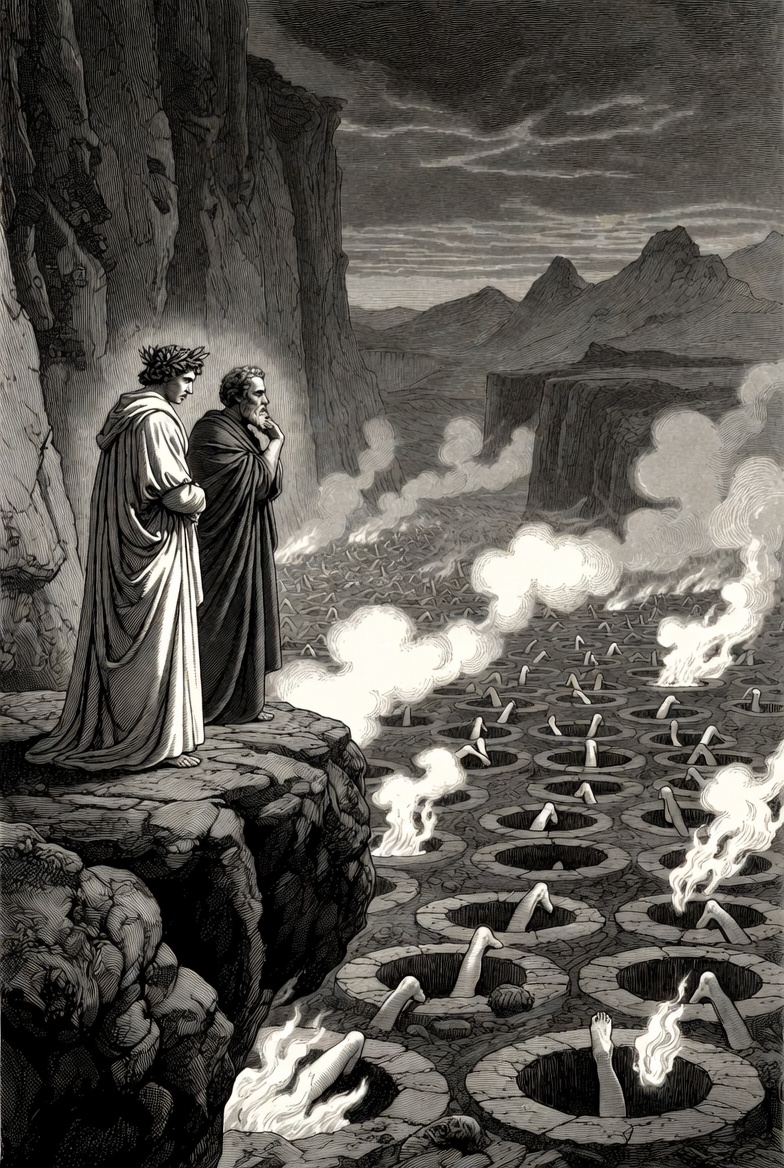
A little on Dante’s inferno for those not familiar:
A little something different with this one, it’s long, but my favourite so far.
I thought to explain privacy, through the analogy of Dantes Inferno
Rather than being highly technical, I thought it better and easier to follow as a story. As we approach the midpoint, it’s a summation of what I’ve been trying to express so far.
Canto I: the dark wood where we begin
Midway upon the journey of our digital lives, I found myself within a dark wood where the straight way was utterly lost.
The feeds scrolled endlessly, algorithmic thickets grew dense around me, and the sun of independent thought seldom penetrated the canopy.
Here I wandered, my eyes fixed upon glowing rectangles, fed by distant oracles who profited from my attention, optimised not for wisdom but for engagement metrics and advertisement revenue.
Every swipe drew me deeper into a forest designed by others, where each path led not toward clarity but toward consumption. I had believed myself free, yet I was captured. I had believed my devices served me, yet I served them. The data I generated enriched platforms I would never control, trained models I would never own, and fed systems designed to make me more predictable rather than more capable.
This was the condition of modern digital life, and I had accepted it as inevitable, as simply the price of participation in the contemporary world.
Then a figure appeared who promised to guide me not downward through circles of damnation but upward through spheres of liberation.
Let us call him Virgil, though he wore the form of a hardware engineer, and he spoke of a device called Pocket Brain where cognition becomes sovereignty, where the second brain is truly yours.
He told me we would ascend through nine spheres, each representing a step away from servitude and toward independence, each layer stripping away another form of digital bondage until we reached the highest sphere where technology finally serves human flourishing without extraction or control.
Before we began our ascent, Virgil paused and spoke seriously about the world we were leaving behind.
True privacy rarely exists.
It has not existed for a long time.
There are two forces working against it.
One, to optimise the experience in terms of accuracy and in terms of speed, data needs to be collected, at least traditionally that is how it was.
Two, data or more accurately what you do with it, is not just valuable but powerful.
Hence, the temptation can often be too great. All consumer electronic devices can leak information, either by the hardware, which is rare, or by the software.
The biggest issue being backdoors. For analogy, this is like having a huge high security front door with high security locks, yet instead of dealing with all that, you instead just walk around the back to open the back door.
Frankly, I have nothing to share that is that exciting. However, if there was a device even similar in nature to the Pocket Brain that essentially knows me better than I know myself, it becomes concerning.
The Pocket Brain is inherently secure by design, making breaches extremely difficult.
Moreover, even if a breach were to occur, the device architecture ensures there is no accessible information layer from which data can be extracted.
This is not security theater. This is security as the foundational architecture, the bedrock upon which everything else is built.
With this understanding, we began our ascent.
First sphere: recognition of bondage
The first sphere through which we ascended was the sphere of recognition, where souls first awaken to the nature of their condition.
Here I saw myself and millions like me, users who had accepted cloud dependency as the natural order, who had never questioned why our intimate data must leave our devices to be processed elsewhere, who had grown accustomed to terms of service we never read and privacy policies written to obscure rather than clarify.
In this sphere, the souls were not yet free but they had opened their eyes.
They saw how the feeds rendered them passive endpoints in optimisation loops designed by others.
They understood that cloud-scale models, brilliant though they were, remained forever distant oracles summoned through apps and queried through clouds, optimised for engagement and revenue rather than for the flourishing of any individual soul.
These models served everyone and therefore served no one completely.
They could not remember your negotiations, could not track your health patterns across months, could not learn that you prefer brevity on Mondays and depth on Thursdays.
They were brilliant strangers, forever.
The souls in this first sphere had begun to ask dangerous questions.
Why must my voice recordings leave my device?
Why must my location history sit on servers I do not control?
Why must the model that assists me belong to a corporation whose interests may not align with mine?
These questions marked the beginning of ascent, the first step away from passive acceptance toward active sovereignty.
Virgil showed me the architecture of the systems I was leaving behind.
Persistent audio buffers uploaded to cloud servers.
Transcripts stored indefinitely.
Raw sensor data streamed to vendors.
Models trained on aggregated data from millions of users, patterns extracted and monetised, behavioural profiles built and sold.
Even the better implementations, like certain privacy-focused cloud compute systems, still required external processing, still created points of vulnerability, still placed trust in entities whose incentives were not perfectly aligned with user sovereignty.
Here in the first sphere, recognition dawned.
The realisation that privacy had become not a feature but a marketing claim, not a reality but a distant aspiration.
The understanding that data minimisation was treated as a compliance checkbox rather than a design principle.
The acknowledgment that vendor lock-in was not an accident but a strategy, that walled gardens were built intentionally, that interoperability was sacrificed deliberately to maintain control.
This sphere was uncomfortable.
Recognition often is. But it was necessary, for you cannot ascend from a prison you do not recognise as such.
Second sphere: rejection of false augmentation
In the second sphere, we moved beyond mere recognition to active rejection.
Here the souls had not only seen the problem but had begun to refuse participation in systems designed against their interests.
They rejected engagement optimisation that turned attention into a commodity to be mined.
They rejected recommendation engines calibrated for dwell time rather than growth.
They rejected dark patterns and manipulative interfaces, consent forms designed to confuse, privacy settings buried under seventeen menus.
This was the sphere of those who had stopped scrolling, who had deleted applications that harvested more than they provided, who had begun to ask not just what technology could do but what it should do and for whom.
Here dwelt the souls who understood that violence against reason is structural, baked into business models that require human attention as their feedstock.
Cloud feeds turned users into endpoints in someone else’s loop, asking not what makes this person sharper but what keeps this person clicking.
Virgil showed me the fraudulent promises of false augmentation, the products marketed as AI assistants that made you less capable over time, atrophying skills rather than augmenting them.
I saw the seduction of products called personalised when they merely A/B tested generic content.
I witnessed the betrayal of systems designed to foster dependence rather than independence, to keep users coming back rather than making them more capable of standing alone.
The souls in this second sphere had learned to distinguish between tools that served them and tools that exploited them.
They had developed immunity to the siren song of infinite scroll, to the dopamine manipulation of notification badges engineered by behavioral psychologists.
They understood that the most sophisticated techniques of modern platforms were deployed not to inform or empower but to extract and control.
This rejection was not Luddism.
It was not a blanket condemnation of technology. It was a careful discernment, a refusal to accept the false choice between technological participation and personal sovereignty.
The souls here knew that better architectures were possible, that the current state of affairs was not inevitable but chosen, not natural but designed, not necessary but profitable for entities whose interests diverged from their own.
Third sphere: reclamation of computational sovereignty
Ascending to the third sphere, we entered the realm where souls had begun to reclaim their computational power.
No longer content merely to reject bad systems, they sought to build better ones.
Here I saw the first stirrings of true on-device intelligence, the recognition that the hardware in our pockets and on our fingers possessed remarkable capability that sat largely idle while we outsourced our thinking to distant servers.
Virgil explained the technical realities that made this sphere possible.
Modern neural processing units like the Snapdragon 8 Elite Gen 5 deliver immense processing power, capable of running sophisticated models locally.
Quantisation techniques that compressed models without catastrophic accuracy loss, making efficient inference practical on mobile hardware.
Low-rank adaptation methods that allowed continual learning with minimal memory overhead, personalising foundation models without requiring full retrains.
The souls in this sphere understood the sweet spot between capability and constraint.
They knew you could not cram a trillion-parameter behemoth onto mobile hardware without melting the device, but they also knew that mid-sized models of one to thirteen billion parameters, properly optimised, could achieve eighty to ninety percent of cloud giant accuracy while sipping milliwatts rather than gulping watts.
They had found the golden mean between the hoarders who demanded impossible computational density and the wasters who left their local processing power entirely untapped.
This was the sphere of practical architecture, of engineering trade-offs made consciously rather than accepted blindly.
Foundation models that shipped with strong baseline capabilities, then narrowed exclusively to individual patterns through efficient adaptation.
Not trained on internet slop scraped from billions of users, but refined through small nightly updates on personal data that never left the device.
LoRA-style adapters representing just a fraction of a percent of model size, incorporating fresh behavioral data without overwriting foundational intelligence.
The souls here had learned that ownership means more than possession.
It means control over training data, control over adaptation, control over inference, control over deletion.
It means models whose weights are encrypted with device-bound keys, exportable if desired, erasable at will. No vendor lock-in because there is no vendor dependency.
The device serves the user, not a distant corporation’s quarterly earnings.
Fourth sphere: restoration of memory and context
In the fourth sphere, we encountered souls who had moved beyond generic intelligence to something deeper, something more integrated with the fabric of their lives.
Here the model had transcended its role as a tool and had begun to function as a true second brain, a cognitive prosthetic that enhanced rather than replaced human capability.
This was not mere file storage or note-taking elevated by marketing language.
This was genuine long-term memory, compressed and cross-referenced, a memory palace of projects and people and decisions that synthesised patterns across months and years.
The souls here possessed devices that recalled past negotiations from voice logs to flag potential concessions in new deals, that spotted health patterns from biometric streams to suggest preemptive rest before illness struck, that revived creative drafts from media history to spark fresh inspiration for current work.
Virgil showed me how this memory operated.
Not as retrieval of isolated facts but as synthesis of context, the same way human memory works not by playing back recordings but by reconstructing meaning from distributed patterns.
The model learned from daily routines tracked through gaze patterns and microphone activation, from interaction logs captured through gesture rings and device queries, from health signals pulsing through biometric sensors, from locations mapped through camera and lidar, from writing and speaking style preserved in voice memos and drafted text.
The difference between this and cloud-based systems was fundamental.
In cloud architectures, your data enriched a general model that served millions, your patterns extracted and averaged, your uniqueness dissolved into aggregate statistics.
Here, in the fourth sphere, the model trained exclusively on your life, adapting only to your evolution, building a representation of your patterns that belonged to you alone.
Over months it developed a hyper-personalized layer that knew your decision-making style, your communication preferences, your health rhythms, your creative patterns.
This was memory in service of foresight, the ability to see not just what happened but what it meant and what it implied for future choices.
The souls in this sphere had regained something that cloud dependency had taken from them, the ability to build genuine long-term context that persisted and deepened rather than evaporating after each session.
Fifth sphere: alignment of values and agency
Ascending to the fifth sphere, we reached the realm where technology had been brought into alignment with individual values and goals.
Here the model functioned not just as memory or assistant but as policy brain, the decision layer that orchestrated action across the entire ecosystem of devices.
The souls in this sphere had encoded their personal trade-offs into the system.
Time versus money versus health, focus versus responsiveness, ambition versus rest.
These were not generic defaults imposed by designers who did not know them but personal calibrations refined through interaction.
The model might delay a low-priority email to preserve deep work time, recognising that this particular user valued sustained concentration over immediate responsiveness.
It might reroute a commute based on accumulated fatigue signals, understanding that this person’s health took precedence over saving fifteen minutes.
Virgil explained how this policy layer orchestrated across the Pocket Brain ecosystem.
It decided what warranted a haptic alert on the node worn at the base of the skull, understanding that interrupting focused thought should be reserved for truly urgent matters.
It determined when to surface augmented reality overlays on the lenses, providing navigation or contextual information without overwhelming the visual field.
It interpreted gesture confirmations through the ring, allowing interaction without breaking flow. It managed the slab as the central processing and display hub, balancing computational load between on-device inference and occasional encrypted cloud queries.
This orchestration was not arbitrary.
It reflected the user’s stated goals and revealed preferences, learning continuously from which suggestions were accepted or rejected, which patterns led to satisfaction or regret.
The souls in this sphere possessed devices that did not merely respond to commands but anticipated needs, that did not merely execute tasks but questioned whether those tasks aligned with longer-term objectives.
The contrast with cloud-fed systems could not be starker.
Where engagement optimisation asks what keeps this person clicking, value alignment asks what makes this person flourish.
Where recommendation engines surface content calibrated for dwell time, aligned systems surface content calibrated for growth.
Where manipulative interfaces bury privacy settings and employ dark patterns, aligned systems make control transparent and accessible.
The souls here had reclaimed agency, not the shallow agency of choosing between predetermined options but the deep agency of having their technology genuinely serve their purposes rather than bending them toward purposes chosen by others.