I’m focusing on the *shape *of China’s battery acceleration (ecosystem + execution), not trying to enumerate every program or budget line.
In China, the solution is less about a single *FULL-MAP *project and more an ecosystem: policy and industry join forces, leveraging AI-powered manufacturing platforms, digital twins, and automated quality control.
The world’s biggest battery players - CATL, BYD, CALB - are investing massively to make large-scale production almost as agile as the discovery lab.
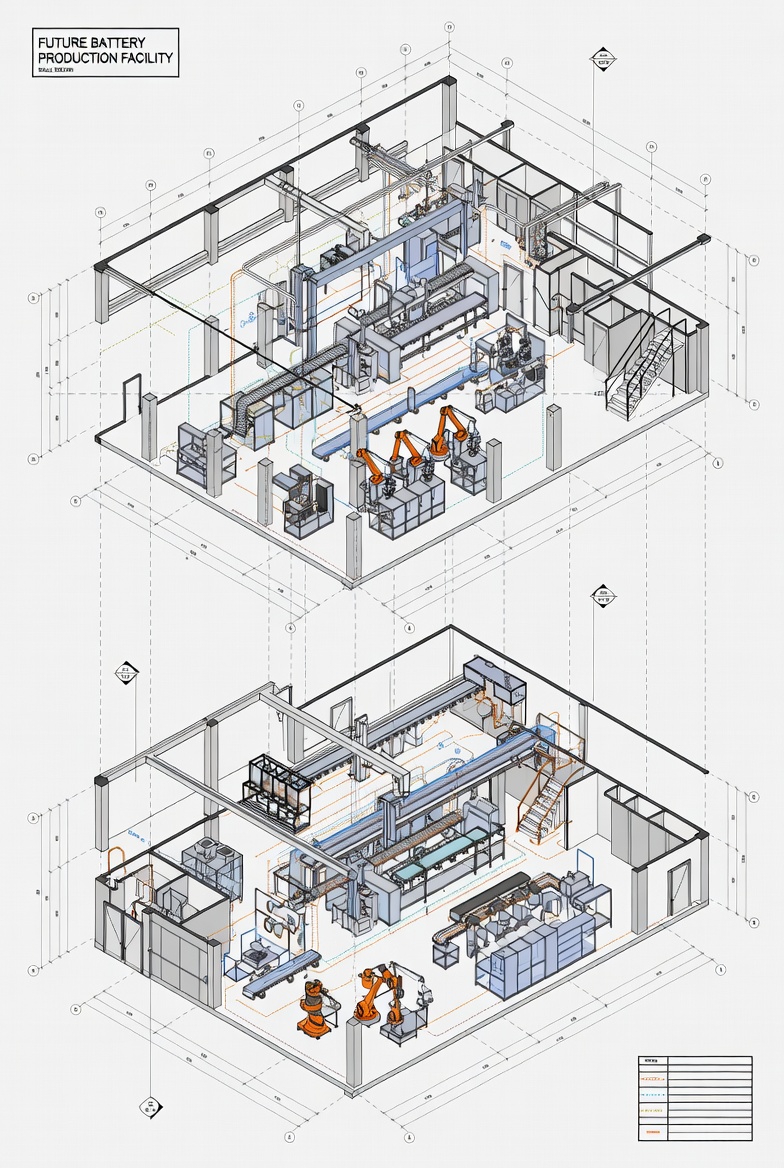
FULL-MAP - Chinese style, the question nobody asks correctly
A quick caveat: tracking Chinese battery innovation is legitimately difficult. Funding flows through multiple channels, central ministries, provincial governments, corporate budgets and state-backed venture funds.
Companies don’t always publish breakthrough timelines in English-language journals.
So some of what follows comes from industry analysis, corporate announcements, and academic papers, not audited government budgets.
That said, it seems there isn’t a direct Chinese equivalent to Europe’s BIG-MAP or FULL-MAP. No €20M consortium with 33 partners and a catchy acronym and no public launch event with ministers shaking hands.
But don’t mistake absence of branding for absence of ambition.
China’s approach to battery acceleration isn’t a single flagship, it’s an entire fleet.
Instead of one structured, publicly funded consortium, you get something arguably more powerful: state strategy, corporate execution, and AI integration so deep it makes Europe’s efforts look almost cautious by comparison.
The pattern seems faster time-to-market, especially when labs and factories sit inside the same orbit.
The national strategy:
Let’s start with China’s ‘New Materials’ 14th Five-Year Plan (2021 to 2025). Think of this as the policy engine driving everything else.
It allocates billions specifically for AI-accelerated discovery of battery components, electrolytes, cathodes, anodes, the works.
Here’s what that actually means:
Instead of researchers manually testing battery materials one by one—a process that can take years—machine learning systems screen over 10,000 candidates virtually before a single physical prototype gets built. It’s the same virtual-to-lab pipeline that BIG-MAP sought to do, but operating at a scale that would make European consortia blush.
Across the 14th Five-Year Plan era, there’s been sustained momentum behind advanced materials and energy storage
*One early win? *
AI-optimised vanadium flow batteries for grid storage, not the lithium-ion cells in your phone, but proof that the system works.
These discoveries feed into the Materials Genome Project, China’s answer to similar Western databases, now holding over 500,000 entries for battery simulations.
*The difference from Europe? *
BIG-MAP emphasises open-source tools and shared databases across countries and companies. China’s approach is more mixed—big players like CATL keep competitive advantages proprietary, but academic initiatives like OpenLAM release open-source models. The real difference isn’t openness versus secrecy, it’s organisational distance.
When the same company runs both the research lab and the factory, discoveries move faster internally.
That’s basic physics of information flow, not national strategy
Then there’s AI4Science, launched in 2023 with massive funding from China’s Ministry of Science and Technology. It scales up the closed-loop idea—AI predicts new materials, robots test them automatically—and rolls it out nationwide. OpenLAM models released in 2024/25 dramatically speed up predictions like ionic conductivity (how fast charged particles zip through a battery), fueling the bigger AI push that links labs straight to factories for quicker breakthroughs.
These aren’t just abstract improvements. The PhD candidates working within AI4Science are gaining expertise that feeds directly into corporate labs and startups, much like BIG-MAP alumni in Europe.
The corporate accelerator:
Here’s where China’s approach gets interesting. While Europe relies on university-industry partnerships, China blurs those lines almost completely.
Take CATL—the Contemporary Amperex Technology Company. They’re the world’s largest battery manufacturer with 38% of global market share. That’s not just a company; it’s effectively a national platform for battery innovation. CATL’s Battery Extreme Manufacturing initiative, centered in Hong Kong, uses computer vision (teaching computers to see defects), machine learning, and massive datasets to automate everything from initial material design to final production.
In practical terms, they’ve used generative AI, to screen thousands of cathode variants in the time it would traditionally take to test dozens.
What does *cathode variant *mean?
The cathode is one of the two electrodes in a battery, and its chemistry determines how much energy the battery can store, how fast it charges, and how long it lasts. Finding better cathode materials used to require years of trial and error.
CATL’s AI does it in months.
In recent years, CATL has pushed cobalt-free LFP cells with strong stability in extreme heat, cold, and rapid charging. Real-world tests show low degradation even after heavy use.
CATL: Semi-solid mass production targeted 2026; all-solid small-scale 2027; experimental cells hit 500 Wh/kg (compared to today’s premium phone batteries at roughly 250 Wh/kg, meaning roughly double the energy density in the same physical space) already applied in aviation and high-end EVs.
BYD to demo a small batch around 2027, scaling toward 2030; sulfide electrolytes + high-nickel cathodes/silicon anodes aim ~400 Wh/kg with excellent cold performance (-40°C) and fast charging capability.
Meanwhile, CATL’s Shenxing series prototypes enable massive fast-charge gains—up to 520 km added in 5 minutes (that’s roughly a full charge for a 500-mile EV), or 80% in ~10-15 minutes even in cold, moving fast toward production vehicles.
The Dalian Institute of Chemical Physics, operating under the Chinese Academy of Sciences, runs AI and machine learning workflows for different battery chemistries. Their 2025 breakthrough in zinc-ion batteries—an alternative to lithium that’s cheaper and more abundant—prevented dendrite formation using machine learning.
Dendrites are tiny metal whiskers that grow inside batteries during charging. They’re one of the main reasons batteries fail or catch fire. By using AI to predict and prevent dendrite growth, they achieved thousands of hours of stable operation. That’s roughly equivalent to charging your phone daily for nearly four years without degradation.
Other players include Huaiyin Normal University collaborating with Singapore’s Nanyang Technological University on protective layers for zinc-ion batteries, and Tianjin University’s National Industry-Education Platform using machine learning to predict battery state-of-health and optimise cathode designs.
Different rules, similar results
Here’s where the comparison gets tricky. China’s battery ecosystem looks fundamentally different from Europe’s BIG-MAP approach, but achieves comparable—sometimes superior—acceleration.
The Scale Question: China isn’t funding one €20M project. The scale is staggering—71% of global battery manufacturing investment in 2025–2026, with $131 billion projected for China alone, dwarfing other regions. Europe’s €250 billion sounds bigger, but includes factories and supply chains, not just research acceleration.
Yet China’s concentration in fewer, larger players means faster decisions and tighter feedback loops.
The Speed Factor: While BIG-MAP and FULL-MAP are still heavily focused on prototypes and validation, China is already commercialising discoveries.
The AI Difference: China emphasises generative models and on-device machine learning for manufacturing, while Europe focuses more on ontologies—structured databases that organise knowledge systematically. Both approaches work, but China’s feels more optimised for rapid iteration.
The Integration Advantage: When a researcher at a Chinese academy makes a discovery, there’s often a direct pipeline to a manufacturer like CATL or BYD. Europe’s multi-partner consortia have to coordinate across countries and competitive companies, which adds friction even as it builds broader consensus.
What this means for your pocket
When you pick up a phone in 2025 or 2026, there’s a good chance, especially with Chinese brands that the battery inside benefited from this AI-accelerated ecosystem.
CATL supplies Apple, Samsung, and most major manufacturers.
But here’s the thing: it’s hard to know from the outside which specific innovations reached your device, versus regular incremental improvements. That said machine learning models trained on millions of charge cycles optimised not just for raw performance, but for real-world conditions—surviving your habits of charging overnight, adapting to whether you live in Helsinki or Houston, maintaining capacity even as you approach your thousandth charge.
The manufacturing precision means batteries that actually deliver their advertised capacity. The AI-driven quality control catches the micro-defects that would cause premature aging. The rapid iteration means last year’s battery breakthrough is this year’s production reality, not next decade’s promise.
Think about what frustrates you about phone batteries: they degrade (sometimes unpredictably), they slow-charge on random days (sometimes), they die at inconvenient percentages (I’ve had this a few times). Many of these problems trace back to tiny inconsistencies in materials or manufacturing. When AI systems screen thousands of material candidates and catch microscopic defects during production, those frustrations simply happen less often.
The uncomfortable reality
Europe has BIG-MAP and FULL-MAP—structured, transparent, collaborative. China has a distributed network of state funding, corporate execution, and AI integration that’s harder to track but demonstrably faster at getting discoveries into devices.
Neither approach is better in some absolute sense. Europe’s open-source philosophy and multi-stakeholder coordination build broader scientific consensus and shared infrastructure. China’s concentrated execution and tight state-industry coordination enable rapid scaling and commercialisation.
But here’s what matters for the device in your hand: the global battery race has shifted from searching for miracles in the lab to competing on whose discovery pipeline moves fastest to market. The PhD working on solid-state electrolytes in Shanghai and the researcher optimising cathode interfaces in Brussels are solving similar problems with similar tools—AI, automation, high-throughput testing.
The difference is what happens next.
In Europe, discoveries move through consortium validation, cross-partner coordination, and pilot programs before reaching production.
In China, they often move straight from lab validation to pilot production, sometimes within the same corporate ecosystem.
Therefore
It’s important to recognise Chinese battery development doesn’t announce itself with press releases and flagship projects. It shows up as the unexpected reliability of batteries that charge faster, last longer, and cost less than seemed possible just a few years ago.
That’s what happens when you compress the timeline between discovery and deployment, when AI screens thousands of possibilities before humans waste time on dead ends, when the same organisation that discovers a breakthrough owns the factories that scale it.
The next time your phone surprises you with how long it lasts on a charge, or how quickly it powers up, or how gracefully it ages compared to your last device—remember this isn’t magic. It’s data, algorithms, scale, and relentless focus on making discoveries matter in the real world, unfolding on both sides of the planet in ways that look different but land in the same place: your pocket*.*
And that’s perhaps the most important takeaway from comparing these approaches—the race isn’t really about who has the best-branded consortium or the cleverest acronym. It’s about who can most effectively transform battery science from fascinating research into reliable technology that you don’t have to think about because it simply works.
That’s the real test of innovation at scale and it’s one China’s battery giants are racing to win.